Namaste,
Among all yogic practices, Surya Namaskar (Sun Salutation) holds a special place. More than just a sequence of physical movements, it is a beautiful combination of movement, breath, mindfulness, and gratitude.
For centuries, yogis have practiced Surya Namaskar as a way to honor the life-giving energy of the sun while awakening strength, vitality, and awareness within themselves. When practiced regularly, this dynamic sequence helps improve flexibility, build strength, boost circulation, and prepare the mind and body for the day ahead.
Whether you are a beginner or an experienced practitioner, Surya Namaskar offers a complete practice that nurtures both physical and mental well-being.
What Is Surya Namaskar?
The Sanskrit words Surya and Namaskar translate to “Salutation to the Sun.”
Traditionally practiced during the early morning hours, Surya Namaskar is a flowing sequence of postures synchronized with the breath. It serves as both a physical exercise and a moving meditation.
The practice symbolizes gratitude for the energy, warmth, and light that sustain life while encouraging us to cultivate those same qualities within ourselves.
Benefits of Surya Namaskar
Regular practice of Surya Namaskar offers numerous benefits for the body and mind.
Physical Benefits
- Improves flexibility and mobility
- Strengthens muscles throughout the body
- Enhances posture and balance
- Boosts blood circulation
- Supports cardiovascular health
- Improves stamina and endurance
- Helps maintain a healthy body weight
Mental and Emotional Benefits
- Reduces stress and mental fatigue
- Improves focus and concentration
- Increases energy levels
- Promotes mindfulness
- Cultivates a positive mindset
Because it combines movement with conscious breathing, Surya Namaskar creates harmony between the body and mind.
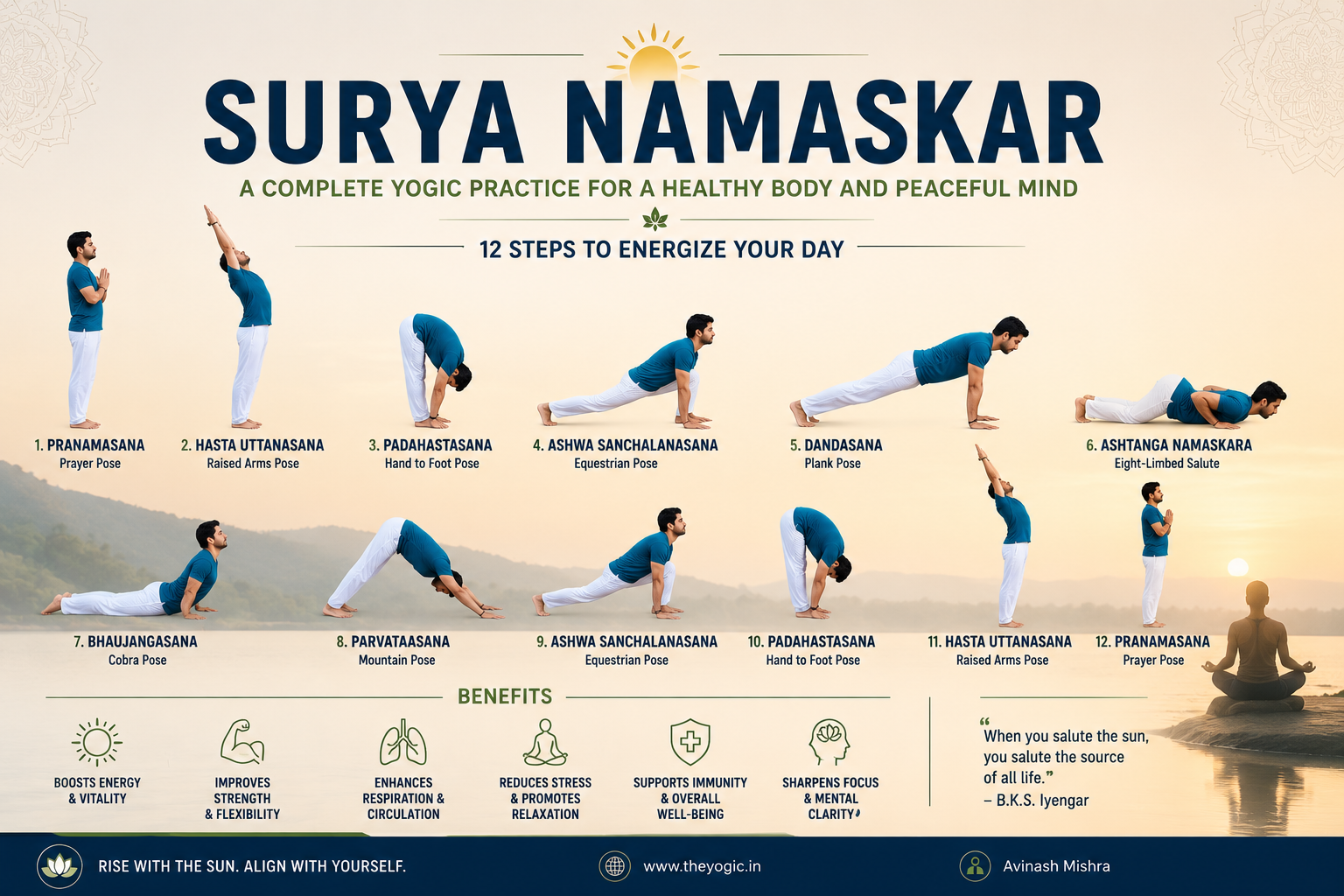
The 8-Step Surya Namaskar Sequence
1. Mountain Pose (Tadasana)
Begin by standing tall at the front of your mat with your feet comfortably together or hip-width apart.
Bring your palms together in front of your chest in a prayer position.
Lengthen your spine, relax your shoulders, and focus on your breath.
Benefits
- Improves posture
- Creates stability and grounding
- Encourages mindful awareness
2. Raised Arms Pose (Urdhva Hastasana)
Inhale deeply and raise your arms overhead.
Gently extend your spine upward and slightly backward while lifting your chest.
Allow the body to open and expand with the breath.
Benefits
- Opens the chest and shoulders
- Improves lung capacity
- Energizes the body
3. Standing Forward Fold (Uttanasana)
Exhale and fold forward from the hips.
Allow your hands to rest beside your feet, on your shins, or wherever is comfortable.
Relax your neck and shoulders.
Benefits
- Stretches the hamstrings and spine
- Improves circulation to the head
- Promotes relaxation
4. Halfway Lift (Ardha Uttanasana)
Inhale and lengthen your spine halfway up.
Place your fingertips on your shins or the floor while keeping your back straight.
Look slightly forward without straining the neck.
Benefits
- Strengthens the back muscles
- Improves posture
- Creates spinal length and mobility
5. Plank Pose (Phalakasana)
Exhale and step or jump your feet back into a plank position.
Keep your shoulders aligned over your wrists and engage your core.
Maintain a straight line from head to heels.
Benefits
- Strengthens the core
- Builds upper-body strength
- Improves stability and endurance
6. Chaturanga Dandasana
Lower your body with control while keeping your elbows close to your sides.
Maintain engagement through the core and legs.
This posture develops both physical strength and mental discipline.
Benefits
- Strengthens arms and shoulders
- Builds core stability
- Develops body control
7. Upward-Facing Dog (Urdhva Mukha Svanasana)
Inhale and lift your chest upward.
Press through your hands and the tops of your feet while broadening across the chest.
Keep your shoulders relaxed and away from your ears.
Benefits
- Opens the chest and heart area
- Improves spinal flexibility
- Increases energy and vitality
8. Downward-Facing Dog (Adho Mukha Svanasana)
Exhale and lift your hips upward and back, creating an inverted V-shape.
Press firmly through your hands and lengthen your spine.
Allow your heels to move toward the floor without forcing them down.
Benefits
- Stretches the entire back body
- Strengthens the shoulders and arms
- Improves circulation
- Relieves tension and fatigue
Completing the Cycle
From Downward-Facing Dog, step or jump your feet forward and return through Forward Fold and Raised Arms Pose before coming back to Mountain Pose.
This completes one round of Surya Namaskar.
Beginners may start with 2–4 rounds, while more experienced practitioners can gradually increase the number according to their comfort and fitness level.
Best Time to Practice Surya Namaskar
Traditionally, Surya Namaskar is practiced:
- Early in the morning at sunrise
- On an empty stomach
- In a well-ventilated and peaceful environment
Morning practice helps awaken the body, increase energy levels, and establish a positive mindset for the day ahead.
However, it can also be practiced later in the day, provided adequate time has passed after meals.
Important Tips for Beginners
- Move slowly and mindfully.
- Coordinate each movement with your breath.
- Focus on proper alignment rather than speed.
- Respect your body’s limitations.
- Avoid forcing flexibility.
- Consult a qualified instructor if you have medical concerns or injuries.
Remember that consistency is more important than intensity.
Final Thoughts
Surya Namaskar is much more than a sequence of yoga poses. It is a complete practice that combines movement, breath, awareness, and gratitude into a powerful daily ritual.
With regular practice, it can improve strength, flexibility, stamina, focus, and overall well-being while helping you cultivate a deeper connection with yourself.
As you move through each posture, allow your breath to guide you and your awareness to remain present. In doing so, Surya Namaskar becomes not just an exercise, but a meditation in motion.
May each round fill you with energy, clarity, and gratitude for the gift of life.
With gratitude,
Avinash Mishra
Founder & Yoga Instructor
The Yogic